




By Carlos Calzadilla, Founder & Outdoor Living Expert
By Carlos Calzadilla, Founder & Outdoor Living Expert
Updated: September 11, 2026
Living in the Carolinas means enjoying beautiful, rolling landscapes and mature trees right in your own backyard. But those picturesque hills hide a stubborn, destructive secret: North and South Carolina red clay. As a homeowner, there are few things more anxiety-inducing than looking out your window after a heavy spring rainstorm and noticing that your landscape retaining wall is starting to lean, bow, or crack. The anxiety of seeing thousands of dollars in landscaping slowly washing away into a muddy, unusable mess is a nightmare that plagues property owners from Raleigh down to Fort Mill.
The hard truth is that retaining walls rarely fail because of the wood or stone you see on the outside; they fail because of the invisible forces hiding behind them. In this comprehensive guide, we are pulling back the curtain on the science of soil dynamics to explain exactly why local red clay destroys standard retaining walls. More importantly, we will reveal the elite engineering standards, premium materials, and hidden drainage systems we use at SunSouth Carolinas to conquer the clay and ensure your hardscaping investment lasts a lifetime.
To understand how to build a wall that lasts, you must first understand the enemy. Carolina red clay is incredibly dense and possesses an extreme shrink-swell capacity. When it gets wet, it acts like a massive underground sponge.
Unlike sandy or loamy soils that allow rainwater to pass through quickly, red clay absorbs the water and holds onto it, expanding rapidly in the process. When this saturated, expanding clay is trapped behind a retaining wall, it creates a phenomenon known as hydrostatic pressure. This is literally tons of outward force pushing directly against the back of your wall.
When the “guy with a truck” builds a retaining wall using treated landscape timbers or standard cinderblocks mortared together, he is building a rigid structure with an expiration date. Wood rots, and rigid concrete cracks. Neither material has the flexibility or the sheer mass required to withstand the relentless, immense pressure of saturated red clay. Once the hydrostatic pressure builds up after a few Carolina thunderstorms, the wall inevitably snaps, leans, and eventually collapses.
Defeating hydrostatic pressure requires a completely different approach. We don’t just build walls; we engineer soil retention systems.
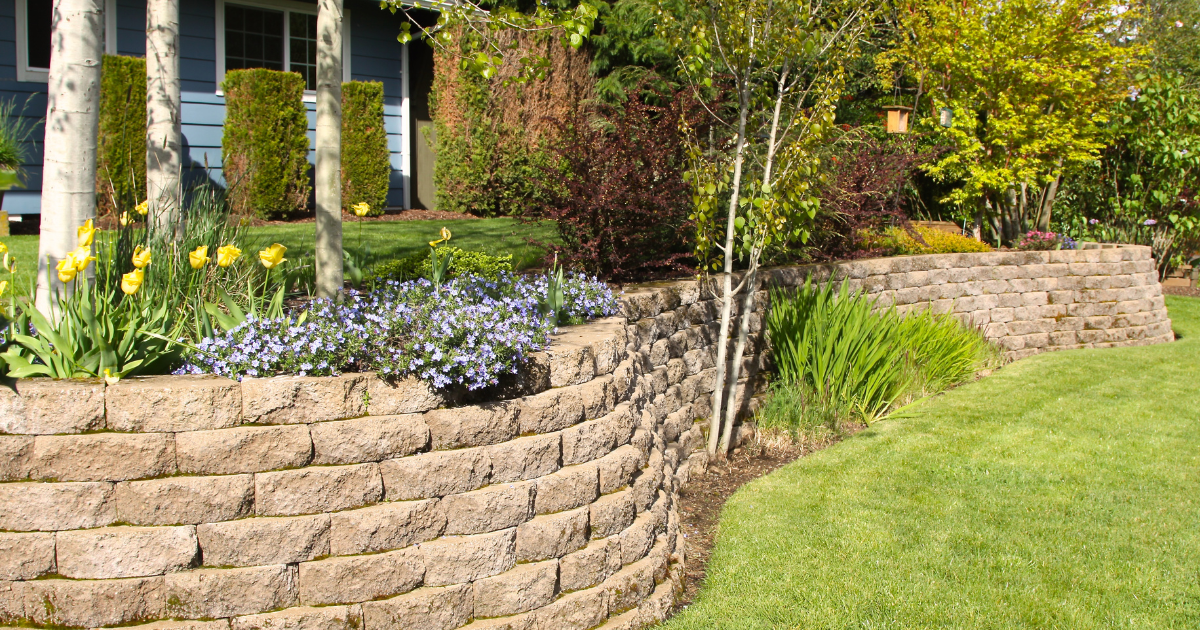
We have completely abandoned timber and rigid mortared concrete in favor of premium segmental retaining wall (SRW) blocks from industry leaders like Techo-Bloc, Belgard, and Keystone. These high-density concrete units are virtually indestructible and completely immune to rot and termites. Because they are installed as individual, interlocking units (often using fiberglass pins or built-in structural lips) without rigid mortar, the wall maintains microscopic flexibility. When the earth shifts during a winter freeze-thaw cycle, the wall can flex slightly without cracking the face of the stone.
A beautiful block face is only the finishing touch. The true genius of a SunSouth Carolinas retaining wall lies entirely underground. To eliminate hydrostatic pressure, we must completely control the water.
We never backfill our walls with the native red clay we just dug out. Instead, we excavate deeply into the hillside and install a commercial-grade geotextile fabric. This fabric acts as a filter, preventing the expansive clay from migrating forward. Between the fabric and the back of the retaining wall, we backfill with clean, open-graded crushed stone (gravel). This creates a massive, porous void. When rain hits the soil, it immediately drops through the crushed stone rather than building up pressure against the blocks.
Gravity pulls the water down through the crushed stone backfill, but it needs a place to go. At the very base of the wall’s foundation trench, we install a heavy-duty, perforated corrugated pipe (a French drain) wrapped in its own protective fabric sleeve. This pipe catches the water and channels it safely out and away from the sides of the wall, ensuring your backyard remains perfectly drained and structurally sound.
For massive, load-bearing slopes or multi-tiered patio designs, gravity and drainage aren’t enough. In these cases, we utilize geogrid—a high-tensile synthetic mesh. The geogrid is sandwiched between the courses of the retaining wall blocks and extended several feet back into the compacted soil of the hillside. This ties the immense weight of the earth directly to the face of the wall, transforming the hillside into one solid, stabilized, immovable mass.
Building a retaining wall that stands the test of time is a structural engineering project, which means it will undoubtedly trigger strict HOA oversight and municipal permitting. In most Carolina counties, any wall holding back significant earth requires a permit and stamped engineering plans.
Trying to secure board approval with a hand-drawn sketch is a recipe for delays. At SunSouth Carolinas, our comprehensive 3D design process eliminates the guesswork. We provide your HOA and local city planners with hyper-realistic renderings and meticulous engineering plans, proving that the wall will safely handle local drainage requirements. We manage the red tape so you don’t have to.
Red clay has extremely low permeability, causing it to act as a sponge that expands rapidly when wet and exerts massive hydrostatic pressure against walls.
The warning signs of imminent failure include leaning forward, horizontal mid-wall cracking, efflorescence (white staining), dry weep holes, and sinkholes forming behind the cap.
They defeat hydrostatic pressure through superior engineering solutions, utilizing segmental interlocking blocks, extensive gravel backfill, geotextile fabric, geogrid reinforcement, and integrated French drains.
You shouldn’t have to lie awake at night wondering if the next heavy rainstorm is going to wash your backyard away. A failing retaining wall is a massive liability, but a properly engineered one is a beautiful, permanent asset that increases your usable outdoor space and skyrockets your property value. At SunSouth Carolinas, we don’t take shortcuts with your home’s foundation. We specialize in designing and constructing heavily engineered, luxury hardscapes that conquer the Carolina climate. We proudly serve the greater Charlotte metro area, Fort Mill, Raleigh, Apex, and the surrounding communities.
About Carlos Calzadilla Founder & Outdoor Living Expert
Carlos is the founder of SunSouth Carolinas and a specialist in transforming outdoor spaces across the Carolinas. With a passion for custom hardscaping and 3D design, he helps homeowners in Fort Mill, Apex, and surrounding areas turn their backyards into functional living spaces. When he’s not on a job site ensuring top-quality construction, he’s sharing his latest projects and design tips on social media.
About Carlos Calzadilla Founder & Outdoor Living Expert
Carlos is the founder of SunSouth Carolinas and a specialist in transforming outdoor spaces across the Carolinas. With a passion for custom hardscaping and 3D design, he helps homeowners in Fort Mill, Apex, and surrounding areas turn their backyards into functional living spaces. When he’s not on a job site ensuring top-quality construction, he’s sharing his latest projects and design tips on social media.
Proudly designing and building custom outdoor living spaces across the greater Charlotte metro area and Northern South Carolina. Our Fort Mill team serves a 20-mile radius, bringing expert hardscaping and 3D design to Fort Mill, Rock Hill, Tega Cay, Indian Land, Lake Wylie, Charlotte (including Ballantyne and Steele Creek), Pineville, Matthews, Weddington, and Waxhaw.
Proudly designing and building custom outdoor living spaces across Wake County and the greater Triangle area. Our Apex team serves a 20-mile radius, delivering high-end hardscaping, custom 3D design, and seamless installations to Apex, Cary, Raleigh (including North Hills and Brier Creek), Holly Springs, Morrisville, Fuquay-Varina, Garner, New Hill, Pittsboro, Willow Spring, and Chapel Hill.
Select your project type below to explore the services and solutions that best fit your needs.
Email: info@sunsouthcarolinas.com
Hours: Mon – Fri | 8:00 AM – 5:00 PM




Copyright © 2026 SunSouth Carolinas | Privacy Policy | Terms of Service | Sitemap
Powered by Studio PECH.


Copyright © 2026 SunSouth Carolinas | Privacy Policy | Terms of Service | Sitemap
Powered by Studio PECH.